Translate my Blog!

Showing posts with label Time. Show all posts

Wednesday, April 10, 2013

Feeling rather alarmed...


Today, while I was driving home, I heard a sound, even while the windows of my car were closed.  I knew instantly what it was and how to respond, as did the other cars around me.  It was the siren of an ambulance.  We are trained to become alert to this, and other sounds like it, similar to the way we recognize and respond to beacons.  Just as visual cues can inform us of our surroundings, so too can auditory.  And for longer than anyone can remember, humans, and animals, have taken advantage of these many different kinds of alarm signals.

Modern usages of the word “alarm” tend to be associated with electronic devices, such as smoke detectors.  But the origin of the word, according to dictionary.com, comes from the French for “the call to arms” ("Alarm")
The word “alert” has a similar definition, originally meaning “to be on the lookout”.  The fundamental difference between the two is that the latter calls for vigilance, whereas the former calls for action. ("Alert")
It’s no wonder then why you may sometimes feel like murdering your alarm, as the word was clearly born of a violent past.  The alarm system has been employed by animals since time immemorial.  In mammals (and humans), it tends to be a vocal response to warn or direct others, but other species sometimes use non-vocal methods to create alarm sounds.
Borrowed from: in-bruges.co.uk

Over time though, humans developed more efficient ways to call others to arms than by voice alone.  Prior to electricity, the bell tower was a popular alarm tool.  The Belfry of Bruges, for example, dates back to before the 13th century A.D., and was used to warn of fires and other dangers.  Bell towers have also traditionally been used to announce less dire events such as marriages, funerals, or simply the time. (The Belfry)

Civil alarms, like bell towers, have since been replaced by electronic counterparts.  Directed at a large population, like a city or a town, sirens were very common throughout America, especially during the Cold War era, due to fear of bombing.  They were used both as a general warning to citizens, and to warn specifically of an attack. (Sirens)

In modern times, we still use many different kinds of alarms.  From your phone, to your car, they are still vital ways of relaying information.  But how will they be used in the future?  I’m sure ringers of bells never would have imagined a technology like the electronic siren, so it’s reasonable to posit that we also have not reached the pinnacle of technology in this area.  One can imagine a future where humans have spread across the stars and neither sound, nor even light are fast enough means of communication.  In this future, when danger approaches, humanity must use a technology so advanced from now that goes beyond even our wildest imaginations.  

Works cited:
"Alarm." Dictionary.com. Dictionary.com, n.d. Web. 10 April 2013.
"Alert." Dictionary.com. Dictionary.com, n.d. Web. 10 April 2013
"The Belfry." in-bruges.co.uk. in-bruges.co.uk, n.d. Web. 10 April 2013
"Sirens." Civildefensemuseum.com. Civil Defense Museum, n.d. Web. 10 April 2013

Wednesday, February 27, 2013

Time is of the essence.

Taken from Wikimedia Commons

For thousands of years humans have passed down histories and tales.  First, by spoken word, and song, but as civilization progressed, people developed writing, and with it, the ability to record and preserve complex information.  The media by which we record information and the efficacy of its preservation has changed drastically overtime, but many examples of these historical messages still exist.  Some Egyptian pyramids, for example, contain treasures, or hieroglyphs which speak of rulers and gods.  We know that the Egyptians generally intended for the contents of the tombs to follow the deceased to the afterlife, but were any of these ever meant to be found again one day?  Whether or not this was the Egyptians’ intent, there are indeed objects and containers that have been buried with the express purpose of being opened by future generations, called Time Capsules.

Although historical artifacts are frequently unearthed, Time Capsules (to the best of our knowledge) are a fairly recent occurrence.  One of the earliest documented Time Capsules is called the Crypt of Civilization.  Created by Dr. Thornwell Jacobs in 1936 at the University of Oglethorpe, Georgia; the capsule’s purpose was to contain accurate records of history for future historians to refer to.  The capsule is not to be re-opened until 8113 A.D.  Jacobs decided on the date by taking the earliest known date in history he could find (4241 B.C., recorded on an Egyptian calendar), calculating the difference between then and his time, and then re-adding the difference (of 6117 years) to the then current date.  The swimming pool-sized chamber that is the crypt contains thousands of items, including books, religious texts, toys, many other contemporary items, and even a device to teach English to those who re-discover it. 
Source: Hyperlink

Although the Crypt of Civilization is widely considered the first of its kind, sometimes Time Capsule-like objects are found dating back even further.  More recently, a Stonemason in Nebraska was restoring a limestone buttress in an old library (which used to be a church).  As he pried in between some of the stones, he hit metal and realized it was not a water line, but a container.  When local historians looked inside, they found church records, a list of members, a leather bound Bible, and a hymnal, among other things, dating back to 1870. 

Although finds like these may not have had specific unearthing dates attached with them, the purpose they share with the modern Time Capsule is clear: to communicate with those from the future.  Although there is no such thing as a time machine, these capsules attempt to achieve the same goal of transcending time to connect with others, and to remind them of the past.  Some Time Capsules are purely sentimental; they may contain personal memorabilia, or letters.  Others are meant to make predictions about the future.

The BurbankTime Capsule, sealed in 1959, contained within it predictions about the city’s state 50 years from when it was written.  The writings foretold atomic energy, massive mall-like living spaces, with 88% of the city’s inhabitants living within them, and an end to parking along the side of the street (of all things).  Although some of these types of predictions resemble modern technologies, such as aircraft capable of vertical take-off, in general these theories from the past reveal the kind of imagination, hope, and even naiveté that our predecessors possessed.  But it’s these same drives that direct us to create new technology, and a better environment for ourselves and for future generations. 
Taken from Wikimedia Commons

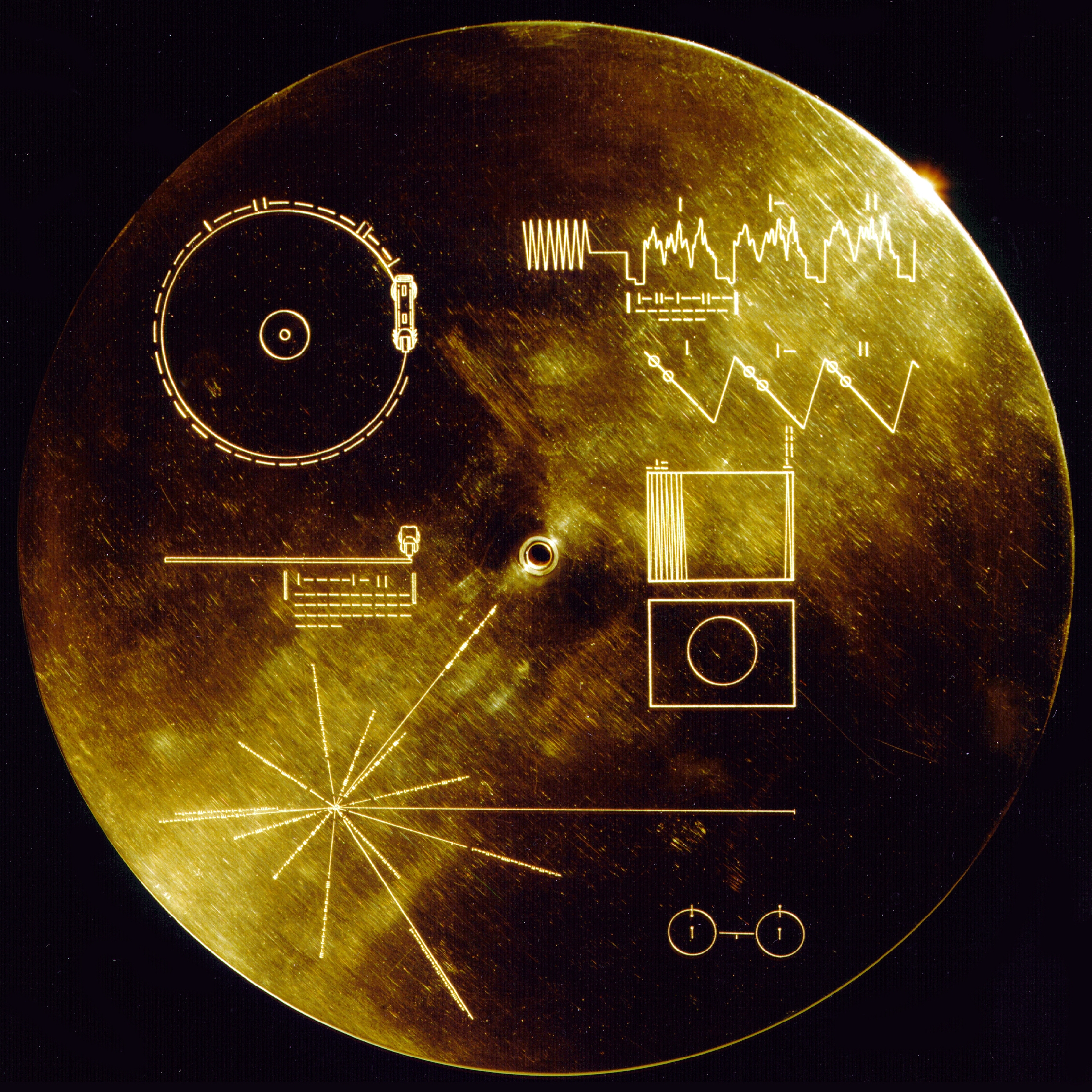
There are numerous other examples of famous Time Capsules from the past, but what kinds of efforts are we making now to communicate with the future?  One example of a modern Time Capsule is located on the Voyager 1 spacecraft, and is, in fact, not on earth at all.  Voyager 1 is currently approximately 18,473,140,350 kilometers from our sun, in deep space, and among its other purposes, it carries with it the Golden Record, which contains both audio and visual information about humanity.  This capsule, however, is not meant to be intercepted by any of mankind’s future generations, but by extraterrestrial life.  
Evidence such as this displays that man’s desire to communicate is so strong, it extends beyond even our own world, and unto others.  Perhaps one day, thousands of years from now, after all memory of our current civilization has been forgotten, we will rediscover a piece of our past, and in doing so, rediscover a piece of ourselves.